Industry News | China’s Foundry Sector in 2024: Lighter, Greener, More Stable—What It Means for Materials in 2025
1) Demand Drivers in 2024: From “usable” to “repeatable”
-
Automotive & EV: Engine/transmission castings continue, but growth is concentrated in motor housings, inverter covers, battery trays, and structural thin-wall aluminum parts. Casting media must support tight tolerances, thin ribs, and clean shakeout at scale.
-
Renewables & General Equipment: Large housings and flanged parts in wind and energy equipment favor stable PSD (particle size distribution) and low thermal growth to curb veining and rework.
-
Aerospace & High-precision: More complex geometries and high-temperature alloys raise the bar for expansion control, micro-defect suppression, and surface finish.
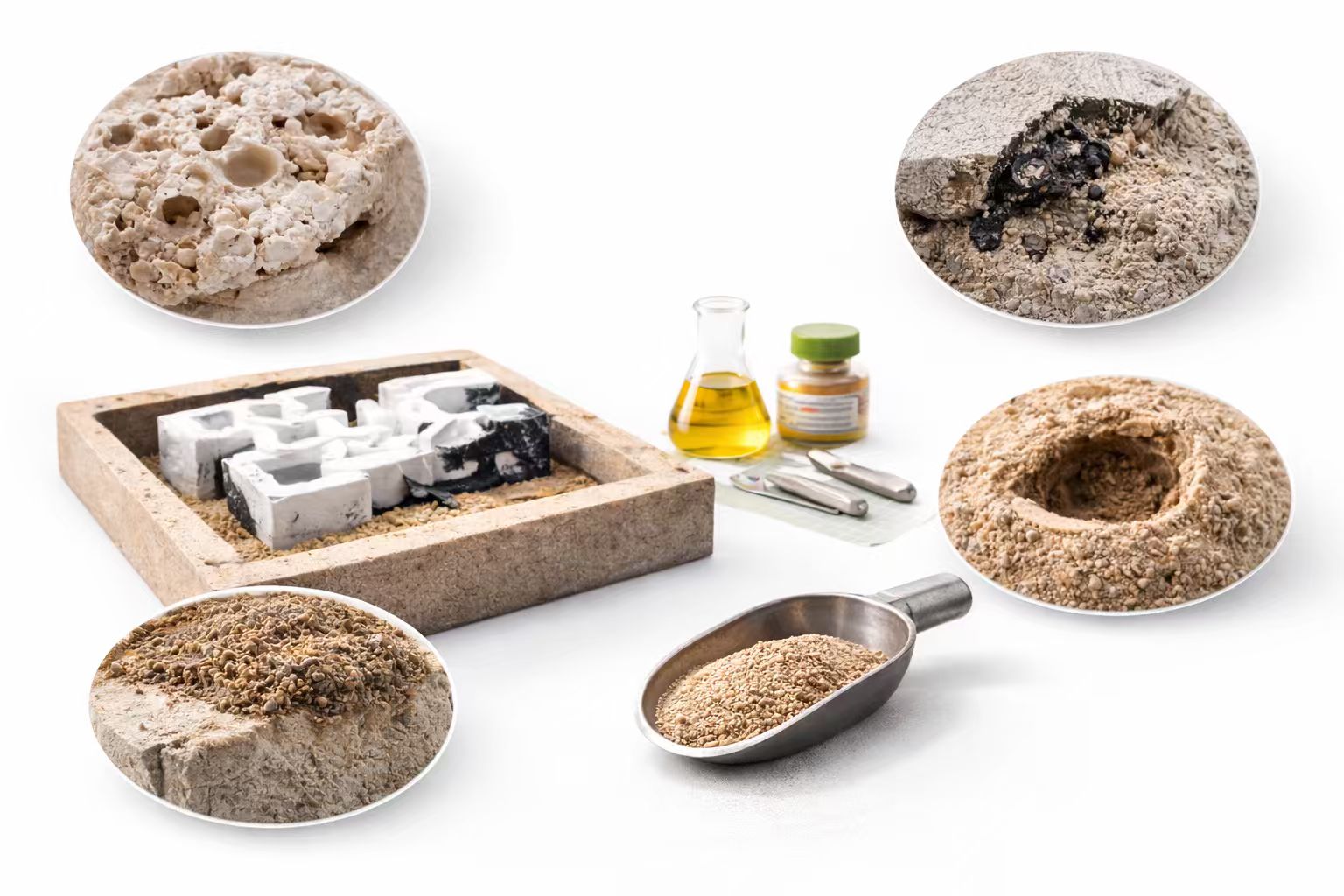
Implication: Foundries increasingly choose engineered ceramic sands—with high sphericity and low thermal expansion—to stabilize geometry and reduce downstream machining.
2) Process & Technology: Shell, resin-coated, and 3D sand printing converge
-
Shell & Resin-Coated Lines remain mainstream for medium/large volumes; consistency and reclaimability are decisive.
-
Binder-Jet & 3D Printed Sand expanded in prototyping and short-run production; the sand must enable dense, even recoating, predictable venting, and accurate layer build-up.
-
Automation/Control: Online grading, temperature control, and closed-loop reclamation push materials toward tight, repeatable PSD and batch-to-batch consistency.
3) Regulatory & Cost Reality: Reclamation and TCO over unit price
-
Compliance: Stricter norms on dust, VOCs, and solid waste elevate the importance of cleaner sands with lower LOI and multi-cycle reuse.
-
TCO Mindset: Procurement weighed scrap rates, machining allowance, tool wear, downtime risk, and reclaim cycles, not just the purchase price. Materials that prevent defects and run 5–10 reuse cycles often win total-cost comparisons.
4) Material Trendline: Engineered ceramic sands displace legacy minerals
Why ceramic sands advanced in 2024
-
Low thermal expansion → fewer veining/burn-on defects, less distortion.
-
High sphericity & uniform packing → fast fill, smoother surfaces, cleaner shakeout.
-
Reclaimability → reduced consumption, better environmental profile.
-
Stable supply → less exposure to price swings seen in certain mineral sands.
5) How TUSHUN materials align with 2024 needs
A) Fused Ceramsite Sand (Baozhu Sand)
-
Use cases: Shell molding, resin-coated systems, cold-box cores, 3D sand printing.
-
Value: Low expansion at casting temperature, rounded grains for rapid fill and uniform compaction, reclaimable with stable D50 after cycles.
-
Result: Lower veining/burn-on, tighter dimensional control, reduced machining time.
B) TUSHUN AluSphere 1# / 2# (Aluminum Casting Sands)
-
Use cases: Aluminum cores/molds across shell, cold-box, no-bake, and binder-jet.
-
Value: Tuned PSD and flow for thin-wall aluminum parts; clean collapsibility and low gas evolution; helps curb porosity and inclusions.
-
Result: Smoother surfaces, faster shakeout, improved yield on EV and automotive parts.
C) High-Strength Ceramic Sand
-
Use cases: Heavy-duty ferrous castings, high-heat or high-pressure sections, long campaigns.
-
Value: Crush resistance and thermal integrity for deep cavities and complex steel/iron parts; predictable reclaim behavior.
-
Result: Fewer core failures, more stable cycle times, lower rework on heavy sections.
6) Line-Trial Checklist (What worked for plants in 2024)
1,Start small, measure broadly: Trial two adjacent molds/cores with the ceramic sand; track scrap modes (veining, burn-on, distortion), surface Ra, and machining minutes per part.
2,Tune temperature & binder windows: Ceramic sands often allow lower binder addition; confirm sand temperature and shooting pressure windows.
3,Verify reclaim curve: Log PSD/AFS after each reclaim cycle (e.g., 3, 5, 8 cycles) to confirm stability and cost savings.
4,Document TCO: Compare scrap, rework, tool life, downtime, and sand make-up vs. legacy media.
7) Risks & Mitigations observed in 2024
-
Learning curve: Switching media alters venting and binder demand—mitigate via a 2–4 week parameter window study.
-
Supply assurance: Lock in grade specs and packaging (e.g., ton bags), and request COA + PSD traceability per batch.
-
Data discipline: Plants with best outcomes tracked sand temperature, humidity, flow index, and green/core strength each shift.
8) Outlook for 2025: Stability, digital traceability, and multi-process compatibility
-
Stability first: Purchasers will prioritize expansion control + repeatable PSD to protect throughput and yield.
-
Digital traceability: Expect broader adoption of material passports (batch data, PSD, LOI, reclaim counts) linked to casting KPIs.
-
One sand, many lines: Materials proven across shell, resin-coated, cold-box, and binder-jet will simplify inventories and training.
Editorial Note—Why this matters now
For China’s foundry base, the 2024 lessons are clear: the winners combined better materials, stricter process windows, and closed-loop reclamation to secure quality, compliance, and cost. In 2025, engineered ceramic sands—backed by data-driven trials and reliable supply—will be central to that formula.
Media Contact / Samples & Technical Data
TUSHUN New Materials Technology Co., Ltd.
Email: zhyl7163@gmail.com
2024–2025 Global Foundry Industry Observation: Reshaping Capacity Structure and Material Selection Amid Fluctuations
Industry News | 2025 Foundry Reality Check: Split Demand, Moving Cost Lines, and Rebuilt Process Windows
Related Article