Technical News | From Materials to Process Windows: A 2024–2025 Technical Map of Foundry Sands
01 | Material Families—moving from “usable” to “controllable”
-
Silica sand – Widely available and economical. The β→α quartz phase transition drives steep thermal-expansion spikes, increasing risk of veining and burn-on/penetration in high-heat zones.
-
Chromite sand – High refractoriness and thermal conductivity, suitable for steel and heavy sections. Higher density raises handling and reclamation energy.
-
Zircon sand – Low expansion and strong metal-penetration resistance; cost and availability can be volatile.
-
Olivine – Lower expansion than silica; niche uses in iron and some Mg alloy contexts.
-
Engineered ceramic/fused sands – High roundness, low thermal expansion, and multi-cycle reclaimability. Penetration into thin-wall aluminum, precision steel, and binder-jet 3D printing continued to rise in 2024.
Takeaway: When specifications demand low expansion, uniform packing, and cleaner surfaces, engineered ceramic media provide a more repeatable window than legacy minerals.
02 | Key Metrics—turn “measurable” into “manageable”
-
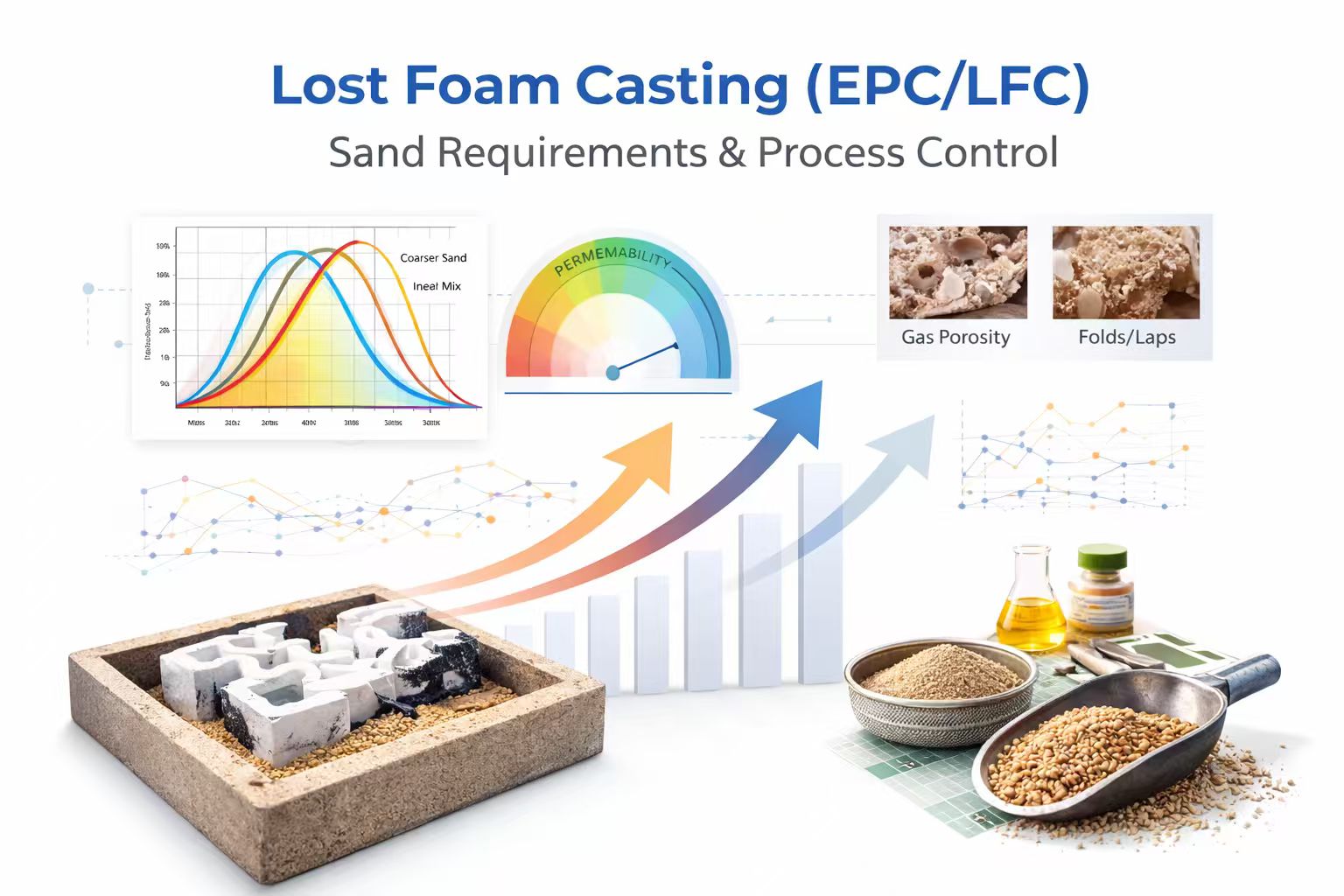
PSD & AFS (D10/D50/D90, tail control) – Controls permeability, fill, and venting. Watch tail growth after reclaim.
-
Shape & roundness (Krumbein or image analysis) – Higher roundness improves flowability, uniform compaction, and release.
-
Thermal-expansion curve – Track slope and inflection between 600–1,000 °C; flatter curves yield tighter dimensions.
-
Refractoriness & anti-sintering – Links to burn-on layer thickness and risk of spall.
-
Bulk vs. true density – Affects sand charge, heat capacity, and temperature swing.
-
LOI & gas evolution – Governs porosity risks; trend with binder system and reclaim level.
-
Chemical compatibility (pH/ADV) – Align with binder chemistry; high ADV often correlates with extra catalyst demand.
Lab protocol (suggested): build a three-point curve—incoming → in-line → reclaimed—tracking PSD/AFS, LOI, ADV, and thermal expansion weekly; close the loop with process adjustments.
03 | Process Fit—materials define “attainable,” process defines “repeatable”
-
Cold-box (PUCB) / no-bake – Prioritize flow, fill, release, and controlled gas. Sand temperature and humidity drive strength and gas evolution—control both.
-
Resin-coated / shell molding – For medium to high volumes. High-roundness sands give uniform coating, stronger shells, and consistent surfaces.
-
3D sand printing (binder jet) – Requires regular grain geometry, dense recoating, and layer stability; monitor sand temperature and fines in real time.
-
Steel & heavy sections – Favor higher refractoriness and anti-penetration; chromite or engineered ceramic media help build stable windows.
Parameter note: Keep sand temperature in a narrow band; tune binder/catalyst to the minimum viable dose, meeting both strength and gas targets.
04 | Defect Mechanisms—fast triage checklist
| Defect | Typical causes | Immediate actions |
|---|---|---|
| Veining | Expansion spikes, stress concentration | Switch to low-expansion media; increase roundness; review chills/risers and cooling path |
| Burn-on / penetration | High-temp adhesion, active surfaces | Raise refractoriness; optimize coating and dry-out; control metal velocity/impingement |
| Erosion / sand inclusion | Excess stream velocity, sharp turns | Redesign gating; use more erosion-resistant media locally; adjust pouring rate |
| Gas porosity | High LOI, hot sand, thick coating | Reduce LOI; stabilize sand temperature; thin/vent coatings; improve vent paths |
| Dimensional drift | Steep expansion curve, reclaim variance | Use low-expansion media; cap fines/LOI; maintain temperature control and reclaim limits |
05 | Reclamation & Circularity—treat it as a “second production line”
-
Mechanical reclaim – De-coating, edge removal, fines control; pair with in-line screening.
-
Thermal reclaim – Cuts LOI and organics; higher energy demand but stabilizes windows for precision lines.
-
Closed-loop governance – Fines and LOI are hidden variables; set alarms/limits and correlate with scrap modes (veining, penetration).
-
TCO lens – Look beyond unit price: scrap, machining allowance, tool wear, downtime risk, energy, and sand make-up define the real economics.
06 | Selection Matrix (quick reference)
-
Thin-wall aluminum / complex cavities – Low-expansion, high-roundness media; compatible with shell, cold-box, and binder-jet.
-
High-temp steel / heavy sections – Emphasize refractoriness and anti-penetration (chromite or engineered ceramic).
-
3D printing – Regular grain, dense recoating, low dust; stable PSD and temperature control.
-
Long campaigns / heavy duty – Anti-erosion and thermal-shock-resistant media; pair with thermal reclaim and fines management.
07 | 2025 Technology Watchlist
-
Engineered properties as defaults – Low-expansion curves and high roundness become standard specs across multiple processes.
-
Digital twins & on-line sensing – PSD, sand temperature, fines, and LOI move on-line, feeding automatic blend and reclaim decisions.
-
Inorganic/low-gas binders – Adoption grows where VOC limits tighten; requires clean, consistent sand baselines.
-
Standardized coupons & data acceptance – Transition from narrative experience to parameter templates for multi-plant replication.
08 | Line-Trial Protocol (what worked in 2024)
-
Pilot in pairs – Trial adjacent molds/cores; track scrap modes, surface Ra, and machining minutes per casting.
-
Map the window – Establish acceptable bands for sand temperature, binder %, shooting pressure, and core bake/dwell.
-
Reclaim curve – Measure PSD/AFS at reclaim cycles 3/5/8; document stability and consumption savings.
-
TCO ledger – Log scrap, rework, tool life, downtime, and sand make-up against the baseline media for a fair comparison.
Closing
The management of foundry sand is shifting from experience-based correction to data-driven control. Plants that convert measurable metrics into managed processes will translate “conformance” into “stability,” and stability into throughput and yield. In 2025, a defect-curve mindset anchored by a disciplined reclaim curve is the most reliable path to better quality and lower TCO.
Editor’s note: Figures and thresholds herein are indicative; always validate with plant-specific trials and safety standards
Same AFS, Different Results: How Thermal-Expansion Curves Drive Veining and Dimensional Drift
Related Article