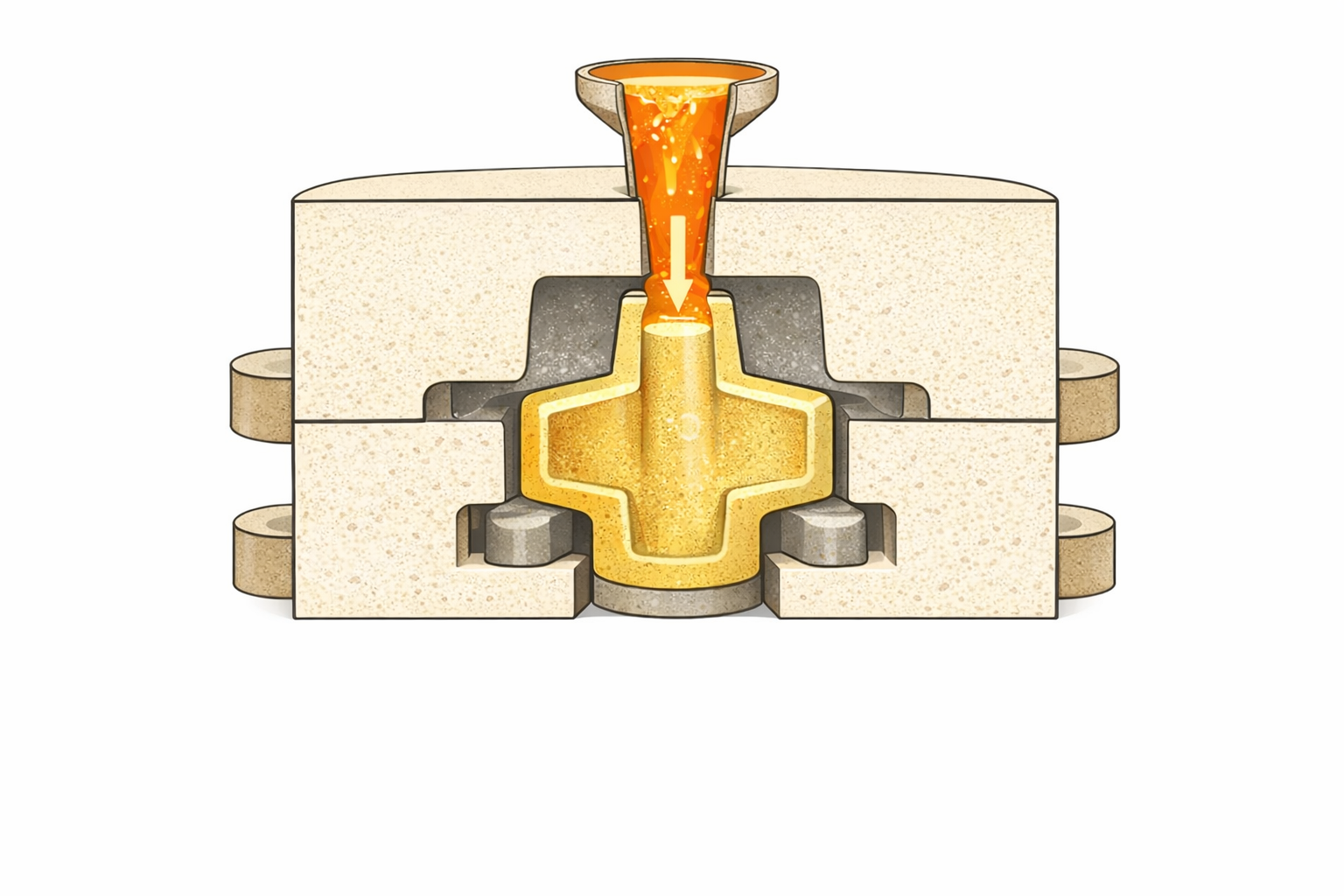
Process Matters: Why Lost Foam Casting (EPC/LFC) Demands a Different “Sand System”
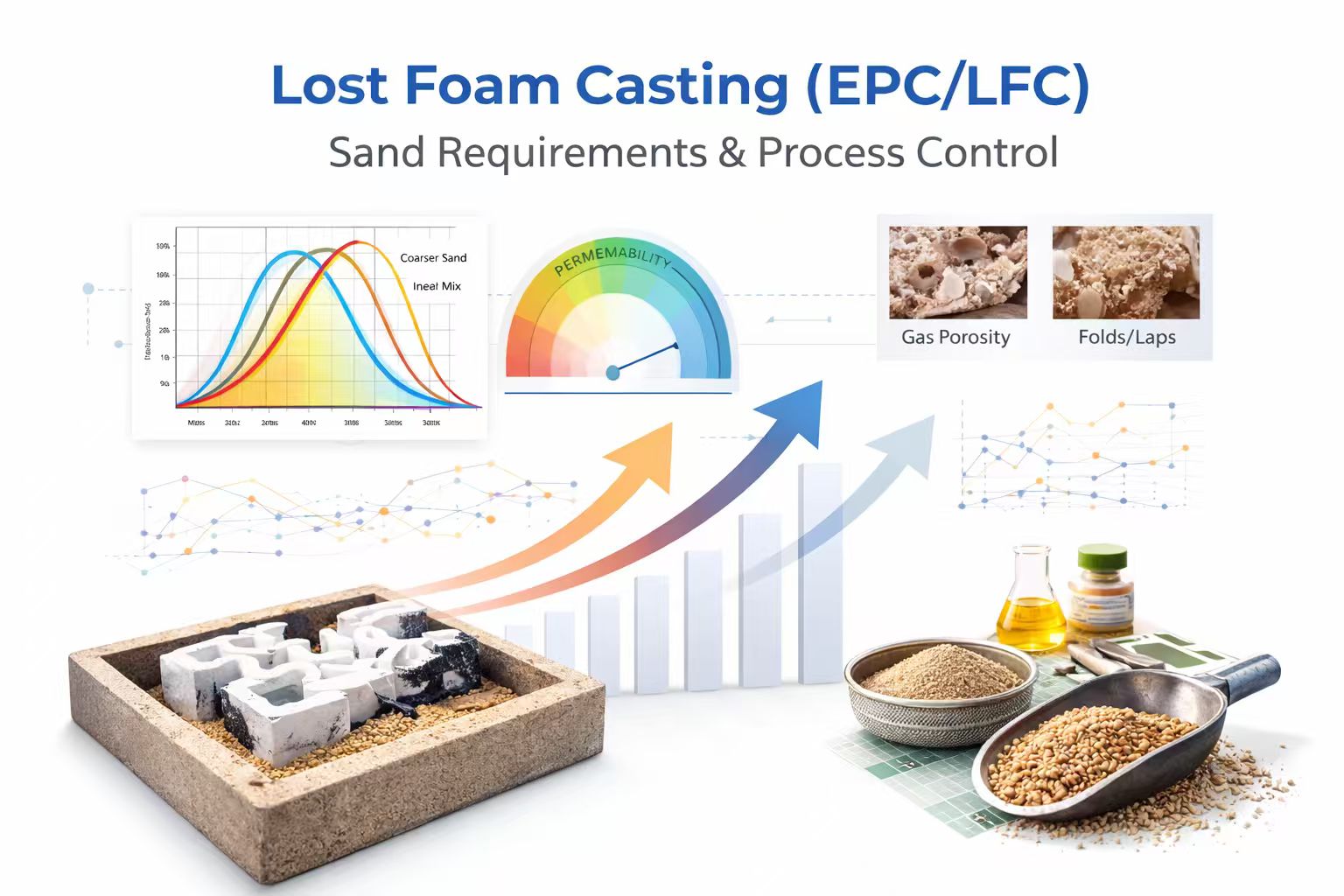
Quick Refresher: How EPC/LFC Works (and Why Sand Is “Active”)
A simplified LFC sequence:
-
EPS foam pattern cluster is assembled and coated
-
Pattern is placed in a flask and filled with dry, unbonded sand
-
Vibration compacts the sand to support foam geometry
-
In many setups, vacuum is applied to help stabilize the mold and improve gas evacuation
-
During pouring, the foam pattern decomposes; metal advances while decomposition products must exit through the coating and sand bed
So the sand isn’t just a “container.” It becomes a dynamic permeability network that can either help the process work beautifully—or trap gases and residues that cause defects.
The “Sand Requirements” That Actually Control LFC Outcomes
1) Permeability is not optional—it’s the process safety margin
In LFC, gas generation is continuous during filling. If the gas cannot escape fast enough, you’ll see a mix of:
-
pinholes / gas porosity
-
folds and laps (especially on thin walls)
-
misruns (from unstable metal front)
-
surface carbon defects or soot-related films (depending on alloy/system)
What to watch: permeability isn’t just a single number; it depends on:
-
particle size distribution (PSD)
-
fines content and dust
-
compaction level (vibration time/amplitude)
-
local packing near complex foam features
Even if your base sand seems “coarse enough,” excessive fines or over-compaction can collapse your permeability where you need it most.
2) PSD stability matters more than “one target AFS”
Many LFC shops fixate on a single AFS fineness number. In practice, two sands with the same average AFS can behave very differently.
What typically works best is:
-
a controlled, repeatable sieve distribution
-
low ultrafine fraction (dust/fines)
-
minimal day-to-day drift caused by reclaim, handling, or broken grains
Why it matters in LFC: the foam decomposes and creates localized gas surges. If parts of the mold pack tighter (more fines, more angular fragments), gas evacuation becomes uneven → defects become “random” and hard to reproduce.
3) Particle shape affects compaction behavior (and defect consistency)
Whether you run silica, ceramic, or other media, the same principle holds:
-
More spherical / round grains → more predictable packing and flow during vibration; less risk of local “locking”
-
More angular grains → higher interlocking; permeability becomes more sensitive to vibration, leading to uneven venting
LFC is unusually sensitive to local compaction variations, so consistency of grain shape becomes a production stability lever.
4) Moisture and contamination: small numbers, big consequences
Because LFC often uses dry, unbonded sand, shops assume moisture doesn’t matter. But even minor moisture pickup (storage, rainy season, insufficient drying, recycled sand) can increase gas generation and reduce permeability.
Contamination drivers often include:
-
dust accumulation in the system
-
coating flakes and residues mixing into sand
-
excessive reclaimed fraction without effective classification
-
oil/grease contamination from equipment
These don’t always cause immediate failure—but they increase defect rate and variability.
5) The coating is a “gatekeeper” between foam decomposition and sand venting
In LFC, the coating does three jobs at once:
-
provides surface finish and reduces metal penetration
-
regulates gas escape (permeability control)
-
improves pattern handling and reduces sand erosion
The reality: coating is where many LFC problems start, because it is the first barrier gas must pass through.
Common failure modes:
-
coating permeability too low → gas pressure spikes → folds/porosity
-
coating too thick or uneven → localized vent restriction
-
coating cracking/peeling → sand erosion, inclusions, surface scabs
A “good sand” can’t compensate for a coating that blocks venting.
A Real-World Style Case (Anonymized Composite from Typical LFC Operations)
A mid-size LFC line casting medium-sized iron components experienced a recurring defect pattern:
-
good overall fill most days
-
sudden spikes of pinholes and fold lines on thin ribs
-
defects concentrated near top sections and complex pockets
What they initially suspected: gating design or pouring temperature.
What the root causes were: a combination of sand system drift and compaction inconsistency.
Key findings:
-
fines content gradually increased due to reclaim and insufficient classification
-
vibration time was extended to “improve surface,” but it over-compacted certain zones
-
coating application varied by operator—some areas were too thick
Corrective actions that stabilized yield:
-
added tighter control on sieve distribution and fines removal
-
standardized vibration settings by part family (not “one setting for all”)
-
introduced simple coating QC: viscosity checks + wet film thickness targets
-
improved sand dryness control during humid periods
The result wasn’t “perfect sand.” It was a controlled sand system—stable PSD + stable compaction + stable coating.
Common LFC Defects and What the Sand System Has to Do With Them
A) Gas porosity / pinholes
Often linked to:
-
insufficient venting capacity (sand packed too dense, too many fines)
-
coating permeability too low or too thick
-
moisture/contamination increasing gas generation
-
unstable vacuum (if using vacuum molding)
First checks:
-
fines/dust level trend over time
-
sieve analysis vs baseline
-
coating thickness and permeability control
-
vacuum stability and leaks
B) Folds / laps / “cold shuts” that look like flow problems
In LFC, folds often come from gas-metal front instability rather than classic turbulence alone.
Contributors:
-
restricted gas exit (coating + dense sand)
-
uneven compaction creating localized gas pressure
-
overly aggressive vibration that creates hard zones near foam surfaces
Corrective direction:
-
restore venting margin (reduce fines, adjust vibration, review coating)
-
keep compaction consistent rather than “maximum”
C) Sand burn-on / penetration / surface roughness
This can be influenced by:
-
coating weakness or non-uniform thickness
-
sand packing instability leading to localized gaps
-
grain shape/size issues causing different contact behavior at the interface
Note: chasing surface finish by over-compacting can backfire by reducing venting.
D) Inclusions / scabs / erosion defects
Often linked to:
-
coating flaking
-
sand erosion from poor compaction in some zones
-
dust build-up in the sand circuit
Fix priority:
-
coating integrity + sand cleanliness + controlled vibration
Practical Control Plan: What a Foundry Should Track Weekly
If you want EPC/LFC yield stability, track the system like a “process loop,” not like a raw material:
Sand
-
sieve distribution (not just average fineness)
-
fines/dust trend
-
moisture (especially seasonal)
-
reclaimed/new blend ratio stability
-
cleanliness indicators (visual dust load, residue)
Compaction
-
vibration settings by part family
-
repeatability checks (time, amplitude, flask fill procedure)
-
local density concerns for complex geometry
Coating
-
viscosity and mixing practice
-
thickness uniformity
-
drying consistency
-
permeability approach (must match the part’s gas load)
Vacuum (if applicable)
-
vacuum level stability
-
leak checks
-
filter/line maintenance
FAQ (For EPC/LFC Engineers and Production Managers)
1) What matters more in LFC: finer sand for surface finish or coarser sand for permeability?
Permeability usually wins first. Surface finish is often better improved by coating control and stable compaction rather than pushing sand too fine.
2) Why do defects suddenly increase after “everything was fine” last month?
Because LFC is sensitive to gradual drift: fines accumulation, reclaim changes, humidity, and operator differences in vibration or coating thickness.
3) Can we fix LFC porosity by only changing gating and pouring temperature?
Sometimes it helps, but if the root cause is vent restriction (coating + dense sand + fines), thermal/gating adjustments often only “move defects around.”
4) Should we always maximize vibration for better mold strength?
No. Over-compaction can reduce venting and create local hard zones, making gas evacuation uneven.
5) What’s the fastest way to diagnose whether the problem is coating or sand?
Compare defect location with coating thickness consistency, then check fines/PSD drift and compaction settings. If defects cluster in pockets/thin walls, venting restriction is a strong suspect.
Technical Feature: How Sand Cores Are Made—and Where Fused Ceramsite Sand Adds Real Process Value
Resin-Coated Sand (RCS) Plants, Unfiltered: Defect Mechanisms and a Repeatable Process Window
Related Article